

With every passing month, the numbers of sales transactions continue to grow for each Finale customer. We have unlocked this valuable data by providing insightful sales velocity data to allow you to quickly learn how well a product is selling and to leverage sales velocity reordering to make smarter data-driven business decisions.
What Is Sales Velocity?
Sales velocity refers to the speed at which products move through your business and produce revenue for your company. You can use sales velocity to predict how much your company can expect to earn during a particular period and to get an estimate of the appropriate amount of product to order.
Some products always have a high sales velocity, while others have a higher velocity seasonally. For example, Halloween costumes sell quickly in October but probably don’t sell much — if at all — during the other eleven months of the year. Understanding when a product is most likely to fly off the shelves allows you to make plans for purchasing based on demand.
Benefits of Mastering Sales Velocity
Understanding your products’ sales velocity delivers many benefits to your company. Some of the reasons why it’s worthwhile to pay attention to sales velocity include:
- It helps you plan for the future: When you know when products are most likely to sell or to linger on shelves, you can make appropriate estimates when stocking your shelves for the future. To return to the Halloween costume example, understanding the speed at which costumes sell in September and October lets you purchase enough to avoid stockouts during that time. Seeing how the sales drop off in November and throughout the rest of the year allows you to purchase just enough costumes so you don’t have to mark many down or have them take up valuable space in a warehouse.
- It gives you an idea of where you stand: Mastering sales velocity gives you a good idea of where your business stands and whether it’s doing well, improving or declining. For example, you might notice that products are moving more quickly, meaning that demand for what you sell is growing. Or, it could be that the market has become saturated, and sales of your products have slowed to a crawl.
- It helps you avoid ordering mistakes: When you know when products sell and how quickly they move, you can avoid ordering too much of something at a particular time of year or too little of it at other times. Understanding sales velocity also helps you see when a product might be losing appeal, meaning you can stock less of it.
- It can help you grow your business: Your sales might not align with your initial expectations for your company, and that’s all right. Recognizing the speed at which products sell and giving time and attention to those that are selling the quickest lets you grow your business. It might be that smaller, less expensive products are the fastest movers. By keeping those products in stock or by stocking similar products, you create more opportunities for your company to grow.
Why High-Velocity Sales Matter for a Growing Business
Getting the reordering process right is perhaps one of the trickiest things for a growing company to master. At first, you are likely to find yourself in a situation where you have too much or too little inventory. Tracking the speed at which products move lets you reach a “just right” point, so inventory doesn’t linger on shelves or in the warehouse and you aren’t left with stockouts or bare shelves.
How to Use Finale Inventory for Sales Management
Being able to access historical inventory levels and analyze what products tend to stay on the virtual shelves longest provides valuable insights that help you make sales velocity reordering that will grow your business.
In addition to product sales velocity, we have all added a “Days Until Stockout” metric to quickly provide you insight into how many days before you run out of stock:
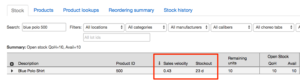
These metrics can be turned on and made visible on the “View Stock Screen” by clicking on the ‘Customize this screen’ link located at the Application Settings drop-down menu.
Additionally, the sale velocity time frame can be configured. The default is set to 30 days and can be changed at Application Settings >> Products:

With the product sales velocity data, customers can go beyond the static min/max reordering method and set up sophisticated dynamic reordering points to make smart purchasing decisions.
Purchasing is one of the most critical and challenging tasks in any retail organization. You want to make customers happy by stocking the products that match their demand while meeting your company’s financial targets.
If you over-purchase, then you’ll have inventory taking up real estate in your warehouse and you’ll spend precious dollars that could have been reinvested elsewhere. If you purchase too little, then you’ll miss sales opportunities by stocking out and frustrating customers in the process.
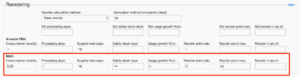
Leveraging the sales velocity of a product, Finale will automatically calculate dynamic reorder points based on your inputs – supplier lead time, desired safety stock, and expected sales growth — to make smarter, faster purchasing decisions.
Take a look at how our customer, Manscaped, leverages the sale order velocity in its daily business operations.
Use Finale Inventory to Master Sales Velocity
Finale Inventory makes it easy for your company to track sales velocity and set up automated dynamic reordering based on sales velocity. To learn more, start a free trial or contact us to schedule a free demo.
What is the first thing I should fix if I want to scale operations?
Start with a unified view of inventory. The core of maturity starts with being able to accurately represent what you do have and make sure that you know where it’s located to get it to customers quickly. Without a unified view across your warehouses, 3PLs, and vendors, you cannot make the best decisions because you don’t have the best information at hand.
With Inventory Visibility, Businesses Can Make Smarter Allocation Decisions
Once inventory is centralized, businesses can move from reactive updates to intentional allocation. They can decide how much inventory to expose to each channel, when to use buffers, which marketplaces need extra protection, and how seasonality or campaign performance influence availability.
Once I know what inventory I have, how should I decide where to make it available?
Inventory allocation should reflect where orders are coming from, where marketing is working, and which channels carry the most risk. Once you know what you have and where it is located, you can think more strategically using centralized inventory to make prioritization happen automatically. One fertilizer company lost a little over 5,000 orders in one weekend because someone manually uploaded the wrong available inventory to Amazon.
Better Inventory Data Improves Planning, Purchasing, and Growth Bets
Better visibility turns inventory data into a planning tool. With insight into sales velocity, inventory levels, vendors, and channel performance, businesses can make more informed replenishment decisions, avoid overbuying, and test new product lines or vendor-supplied inventory without taking on unnecessary risk.
How does better inventory data help me make smarter buying decisions?
It lets you measure whether your plan is working before you commit more capital. A key question becomes: “Did my plan work? Am I overleveraged in one place or another?” Centralized systems can also help businesses test new product lines or vendor relationships by looking at sales velocity by channel, allowing them to take risks in a calculated and measured way.
Intelligent Order Routing Turns Inventory Complexity Into Automation
Once inventory and supplier data are reliable, businesses can automate fulfillment decisions. Orders can be routed based on cost, speed, margin, location, warehouse priority, vendor fallback, split-shipment rules, or customer expectations. This helps hybrid fulfillment scale because every order does not need a manual review.
How do I decide the best way to fulfill each order?
There is no single answer, which is why order routing needs to account for the context of each order. Intelligent order routing is not just sending an order to someone who has stock; it is taking each and every order and treating it like its own unique use case. Depending on the order, the business may prioritize speed, margin, an internal warehouse, vendor fallback, or preventing split shipments.
Supplier Inventory Sync Extends Inventory Beyond the Four Walls
For hybrid fulfillment to work, supplier inventory needs to become part of the operating model. Supplier sync does not always require advanced technology; it can happen through automated files, FTP, email, APIs, EDI, or ecommerce storefront integrations. The key is replacing manual updates with automated, reliable supplier data.
Can supplier inventory really be treated like part of my own inventory?
Yes, but the goal is not necessarily to force every supplier into a complex integration. Real-time supplier sync can be defined as any way to get an automated update from a supplier, such as Google Sheets, email, FTP, API, EDI, or ecommerce storefront connections. The key is that accurate supplier stock is foundational. If you don’t have an accurate view of what is in stock with your suppliers, you cannot tell your sales channel accurately what’s available.
Exception-Based Workflows Keep Humans Focused Where They Matter
Automation does not remove people from the process. Mature operations let technology handle the routine majority while humans focus on exceptions, such as high-value orders, fraud risk, compliance requirements, restricted products, export rules, or unusual fulfillment scenarios.
If my business has special cases, can automation still work?
Yes. The point is not to automate every possible decision; it is to automate the routine work and surface the exceptions. Businesses should not have to look at every single order. Instead, technology can highlight high-value orders, risky locations, or compliance requirements. The goal is to take care of the 80% of workflows that are obvious while still allowing human review when specific exceptions arise.
The Right Inventory Technology Should Fit the Business, Not Overwhelm It
Software decisions should be based on business fit, not popularity, feature volume, or broad “all-in-one” promises. Growing ecommerce businesses should identify their highest-impact bottleneck, prioritize what matters now, and choose technology that is right-sized but flexible enough to support future phases of growth.
How should I choose software without overbuying or picking the wrong system?
Start with your priorities, not the biggest feature list. Avoid an all-in-one system that claims to “do everything under the sun” and look for a “best of breed approach” with systems that can scale as you add channels or vendors. The practical advice is to stack rank what matters now, make sure the system can support future phases, and choose technology that fits your business rather than overwhelming it.
How to Scale Ecommerce Operations Beyond Spreadsheets
For many growing ecommerce businesses, Finale and Flxpoint work together as a practical answer to these challenges. Finale helps centralize and manage internal inventory, purchasing, warehouse operations, and stock visibility, while Flxpoint helps connect vendor inventory, automate supplier sync, and route orders across hybrid fulfillment networks. Together, they give businesses a best-of-breed way to improve inventory accuracy, reduce spreadsheet work, and scale fulfillment without forcing every process into a one-size-fits-all system.
Ecommerce Fulfillment Operations FAQ
What Is Ecommerce Fulfillment Operations?
Ecommerce fulfillment operations are the processes that move an online order from purchase to delivery. This includes managing inventory, syncing product availability across channels, routing orders to the right warehouse, 3PL, supplier, or vendor, and making sure the customer receives the right product on time. As discussed in the webinar, fulfillment is no longer limited to “what’s in my warehouse these days”; growing businesses may rely on internal warehouses, 3PLs, marketplace fulfillment services, and supplier inventory at the same time.
What Are Ecommerce Fulfillment Operation Examples?
Examples of ecommerce fulfillment operations include updating inventory across Shopify, Amazon, Walmart, and other sales channels; allocating inventory to specific marketplaces; sending orders to an internal warehouse, 3PL, or vendor; syncing supplier inventory through files, APIs, EDI, email, or FTP; replenishing warehouse stock based on sales velocity; and flagging exceptions such as high-value orders, compliance requirements, or restricted products. In the webinar, the speakers also discussed hybrid fulfillment examples where a business may fulfill some products from its own warehouse and use vendors as a fallback or extension of available inventory.
How Can I Track My Inventory at an Ecommerce Fulfillment Center?
The best way to track inventory at an ecommerce fulfillment center is to create a unified inventory view that shows what is available, where it is located, and how that inventory connects to each sales channel. That means tracking inventory across internal warehouses, fulfillment centers, 3PLs, marketplace fulfillment programs, and supplier locations instead of relying on disconnected spreadsheets. The webinar emphasized that businesses need to “accurately represent” what they have and know where it is located so they can get products to customers quickly.
How Can I Connect My Inventory to My Supplier?
You can connect supplier inventory through several methods, depending on what the supplier supports. The webinar discussed low-tech and advanced options, including automated Excel or CSV files, Google Sheets, email updates, FTP servers, APIs, EDI, and direct connections to ecommerce storefronts such as Shopify, BigCommerce, or Magento. The key is to ask suppliers how they share inventory today, then use a system that can automate that data flow instead of manually copying supplier inventory into spreadsheets.
What Is Ecommerce Order Routing?
Ecommerce order routing is the process of deciding where an order is fulfilled from after a customer buys. In a simple operation, every order may go to one warehouse. In a more complex or hybrid fulfillment model, the best fulfillment source may depend on inventory availability, shipping speed, cost, margin, customer location, warehouse priority, vendor fallback rules, or whether the order should be split. The webinar described intelligent order routing as treating each order like its own use case, so businesses can automate the best fulfillment decision without manually reviewing every order.