

Key Takeaways
- Lot numbers identify product batches, while serial numbers identify individual items. lot number is shared across a group of products with something in common, while a serial number is unique to one item.
- Lot numbers are best for batch traceability and recalls. They help businesses trace groups of goods across manufacturing, distribution, and customer delivery, making recalls and quality investigations faster and more targeted.
- Serial numbers are best for item-level tracking and after-sales support. They are especially useful for products with warranties, service histories, returns, or configuration-specific support needs.
- Both lots and serial numbers are typically tracked with inventory software and barcodes. While paper-based tracking is possible, the page explains that most companies use inventory management software and barcode scanning to improve speed and accuracy.
- Choosing between lots and serial numbers depends on the product and operational needs. Lot tracking fits batch-based, regulated, or recall-sensitive products, while serial tracking is more appropriate for high-value or service-heavy items like electronics, cars, and appliances.
Introduction to Lot Tracking & Serial Numbers
Controlling your inventory — whether you have one facility or dozens — can be a daunting task. With hundreds and thousands of products entering and exiting your site each day, how do you keep track of everything? The best solution is to organize your merchandise via lot tracking and serial numbers to keep tabs on your grouped and individualized items.
With cloud inventory management software from Finale Inventory, you can oversee each asset and regulate your warehouse management. Our flexible, secure and convenient solutions help you recognize and eliminate problems within the manufacturing process while staying organized and in-line with various government regulations.
What Is Lot Tracking?
What is a lot? Lots, also called code numbers, batch numbers or lot codes, identify a particular number of products in a single group that have common properties. A commonality in lot tracking can be anything from containing the same material to being manufactured in the same batch. There is a one-to-many relationship, as many products can have the same lot ID.
Lot numbers combine numerical digits to a group of products that have commonalities, but there is no one way to assign the figures. For example, companies can allocate numbers to their product batches based on location, manufacturing date or expiration date. Regardless of how you establish the number sequence, it’s a unique identifier that applies only to that particular set of goods. Individual products within the batch will have the same lot number, but you cannot use the lot number on any other group.
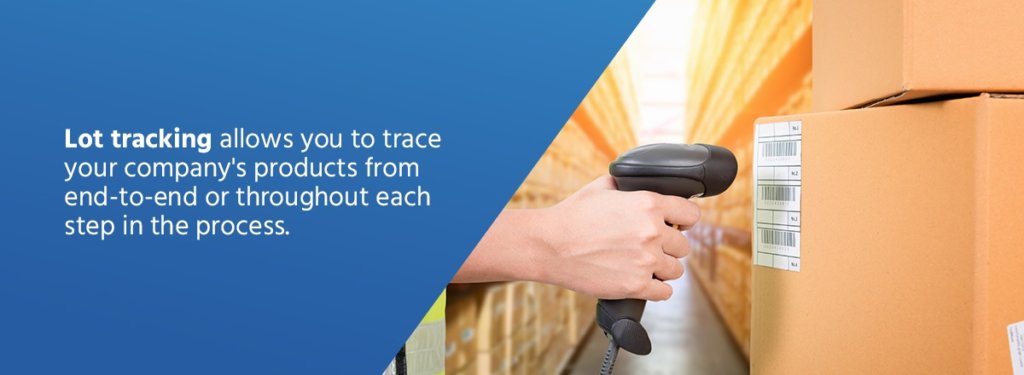
Lot tracking allows you to trace your company’s products from end-to-end or throughout each step in the process. From the beginning manufacturing stages to their arrival at the supplier, distributor and end customer, you can trace the goods throughout their entire journey.
Lot numbers can help you trace quality control, reporting, recalls and other information like production faults. They also aid you in tracking which clients receive particular batches of product, as well as the date of purchase, collection time, expiry dates, manufactured dates and supplier info. With the ability to retrieve details about any group of products along the supply chain, you can remain compliant with regulations from the U.S. Food and Drug Administration (FDA), the Canadian Food Inspection Agency (CFIA) and the International Organization for Standardization (ISO).
You can often find a production lot number on the outside of an item’s packaging, as well as your records and inventory management software from Descartes Finale™.
What Is Lot Tracking?
What is a lot? Lots, also called code numbers, batch numbers or lot codes, identify a particular number of products in a single group that have common properties. A commonality in lot tracking can be anything from containing the same material to being manufactured in the same batch. There is a one-to-many relationship, as many products can have the same lot ID.
Lot numbers combine numerical digits to a group of products that have commonalities, but there is no one way to assign the figures. For example, companies can allocate numbers to their product batches based on location, manufacturing date, or expiration date. Regardless of how you establish the number sequence, it’s a unique identifier that applies only to that particular set of goods. Individual products within the batch will have the same lot number, but you cannot use the lot number on any other group.
Lot tracking allows you to trace your company’s products from end-to-end or throughout each step in the process. From the beginning manufacturing stages to their arrival at the supplier, distributor and end customer, you can trace the goods throughout their entire journey.
Lot numbers can help you trace quality control, reporting, recalls and other information like production faults. They also aid you in tracking which clients receive particular batches of product, as well as the date of purchase, collection time, expiry dates, manufactured dates and supplier info. With the ability to retrieve details about any group of products along the supply chain, you can remain compliant with regulations from the U.S. Food and Drug Administration (FDA), the Canadian Food Inspection Agency (CFIA) and the International Organization for Standardization (ISO).
You can often find a production lot number on the outside of an item’s packaging, as well as your records and inventory management software from Finale Inventory.
Lot Inventory Tracking
Lot inventory tracking is the documentation of how each good moves in and out of your company’s inventory. It can categorize the materials coming into your facility to help you manufacture a product, as well as finished goods leaving for a supplier or distributor.
When you record each lot number to your reporting system, it helps you see trends within specific groups. It also aids you in understanding the flow of production and whether you generated a profit or loss. Detecting common patterns, like returns from the same lot, can indicate a defect.
Inventory management software is essential if you demand streamlined support because it’s ideal for multi-channel businesses that work with numerous suppliers and manufacturers.
You can understand the idea of inventory tracking through three concepts:
- Barcodes: A barcode scanner is a more accurate and efficient way to record your stock compared to manual input.
- Inventory management software: It’s essential to partner with the right software solution that will work with your barcode scanner and other tools. The inventory management program can keep you up to date on individual lots and the inventory as a whole.
- Lot tracking: Lot tracking is software designed to trace lot and serial numbers.
When you know where your product batches are throughout the manufacturing and distribution processes, it’s easier to handle different situations and to understand various trends.
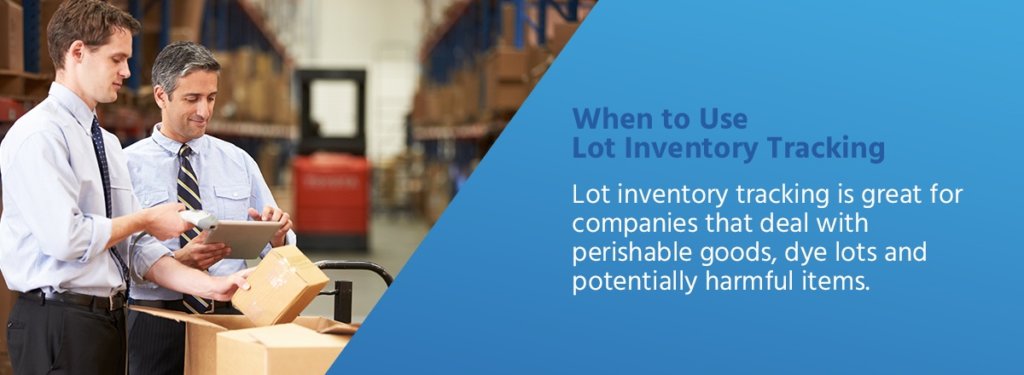
When to Use Lot Inventory Tracking
Lot codes are ideal for batches of products you make or receive in high quantities. It’s easy to attach the same code number to a group of similar products and store them together for simple locating. Lot inventory tracking is great for companies that deal with perishable goods, dye lots, and potentially harmful items. Other industries that benefit from the system include the medical and pharmaceutical sectors, automotive plants, and manufacturers of children’s products.
You can rely on lot tracking for various uses:
Fabric Production
Yarn and fabric use lot tracking via dye lots. A dye lot classifies yarn, fabric, or clothing according to their coloration during the same process.
However, dyeing fabric is a method that can’t always guarantee the same color each time. Productions of the same colors can result in different shades, even if they came from the same roll of fabric.
This is common when mixing a new batch of dye and ink to recreate a particular color. Factors like temperature and dyeing time can affect the shade of the same color between various dye lots of an otherwise duplicated process. As a result, fabric manufacturers assign each lot a unique identification number and stamp it on the label before shipping.
Fireworks Distribution
The Bureau of Alcohol, Tobacco, Firearms, and Explosives (ATF) requires importers to identify and keep records of all fireworks imported for distribution. If a firework importer brings display fireworks into the United States, the products must have lot tracking in the form of the date and shift of manufacture.
Food & Beverage Production
A food manufacturer could make 1,000 bottles of ketchup in an eight-hour shift. Each would have the same lot ID used to track the manufacturing date or expiry date.
Milk uses lot tracking in the form of the “best-by date.” A batch of milk is a set of individual containers that possess the same ingredients and have an identical best-by date because they were produced together.
Producers apply the best-by date to let you know when the milk will taste its best and when stores should stop selling the carton. However, milk is often fine to drink after its expiration date by several days.
Using lot inventory is beneficial for a range of manufacturers. Internal instances, such as legal compliances, product recalls and quality assurance, also rely on inventory trackings:
- Legal regulations: The FDA and other organizations require lot tracking for food, drugs, firearms, fireworks and retail companies. Research your local and state laws to ensure you’re complying with different lot tracking standards.
- Product recalls:Product recalls are typical — you often can’t avoid them. If a recall happens at your facility, you can easily apply the recall to the items with the same lot number as the faulty item as opposed to recalling all the products you’ve manufactured.
- Quality assurance: Assigning lot numbers to goods helps with your quality assurance procedure. If you find a defective item when testing various batches, you can locate its group and pull those products from the line if none of them meet your company’s standards. It’s easier and more economical than taking down the entire product line.
When Not to Use a Lot Number
If the products you manufacture have a low likelihood of returns due to production failure, lot numbers are not necessary. For example, it wouldn’t make sense to use lot codes if you store consumable products like toilet paper, paper towels, pens, and other non-perishable goods.
What Is Serial Number Tracking?
What is a serial number? Serial numbering is a set of unique identifiers assigned to individual items within a batch of products. You can have a group of goods with the same lot number, but serial numbers will differentiate them from one another. What does serial mean, compared to a lot code? Unlike lot IDs, serial numbers have a one-to-one relationship, as a unique number goes to a single product. No other product can exist with the same serial number.
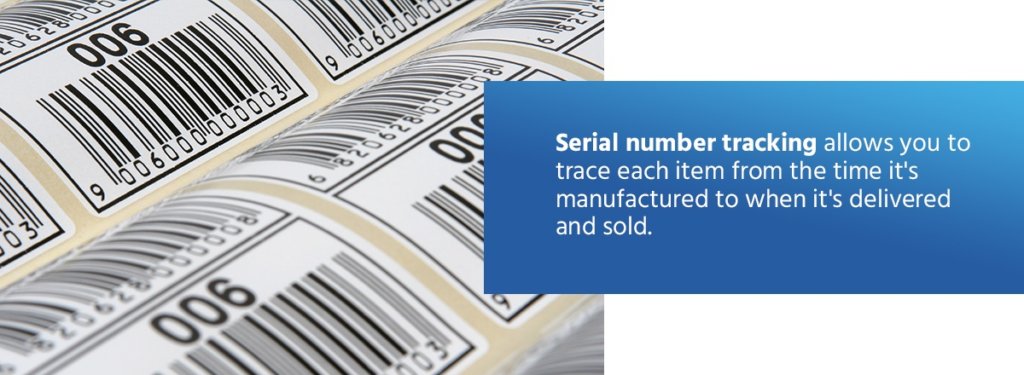
Can Serial Numbers Be Traced?
Serial number tracking allows you to trace each item from the time it’s manufactured to when it’s delivered and sold. The identification number given to one product enables you to track its history. This number helps with record-keeping, accuracy, and compliance, which is especially crucial for highly-regulated industries that manufacture products with specific variants.
If a variation occurs during production in one of your components, the product’s serial number will help you pinpoint the specific item with the issue. This form of tracking also enables you to see what’s in stock while identifying the details of everything that enters and leaves your facility. A serial number provides all the information about an individual item, like its size, color, configuration, weight, and dozens of other specifications.
Tracking even helps you see which goods are more popular than others. These trends can help you stock and prepare for future manufacturing quantities. Serial numbers also reduce shipping errors, which is especially critical for the medical and pharmaceutical industries.
At Finale, our cloud inventory management systems can accommodate various serial code schemes for a multitude of businesses.
When to Use a Serial Number
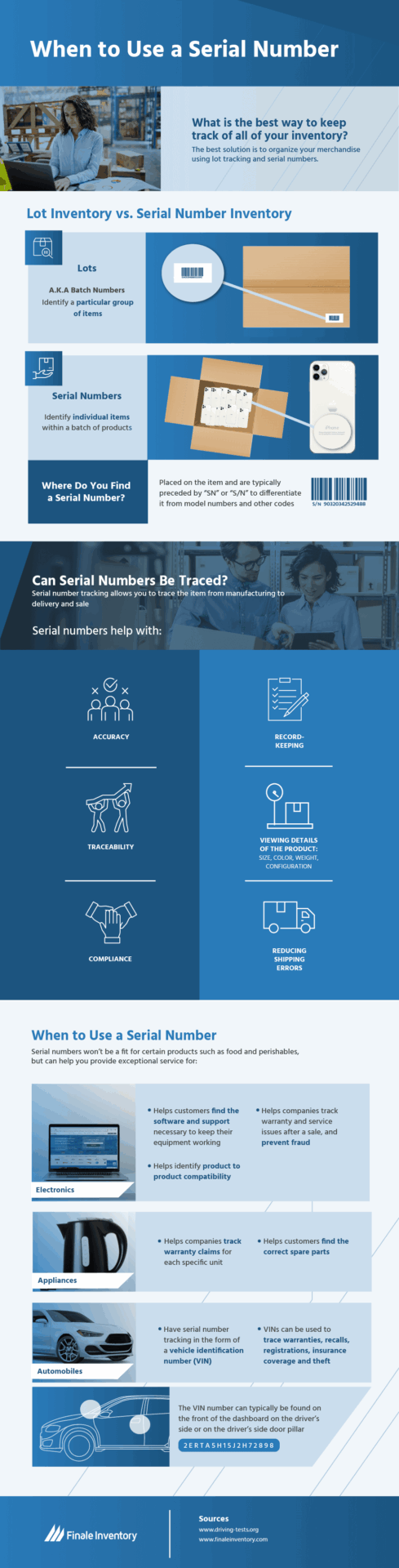
Implementing a serial number sequence within your inventory is ideal when your products are under warranty or uphold after-sales services. If an item is faulty or returned, you will have accurate, complete data to support your clients and customers.
Serial numbers won’t support every product because the process is time-consuming. It also wouldn’t make sense to use serial numbers for food items. Instead, it’s helpful when manufacturing technology like laptops, cell phones, headphones and tablets, as well as automobiles and appliances. Because consumers often demand support with these products, you can track down their specific merchandise to provide exceptional service:
Appliances
Appliances have serial numbers to allow customers to find the correct spare part by entering the number on the manufacturer’s site. Additionally, the serial number allows companies to track warranty claims for each unit.
Cars
Cars have serial number tracking in the form of a vehicle identification number (VIN). The car’s VIN identifies a specific vehicle, where no two automobiles can have the same ID. A VIN has a total of 17 numbers and letters that distinguish each automobile. You can use the VIN to trace warranties, recalls, registrations, insurance coverage, and even theft.
Electronics
A serial number identifies computers, cell phones, and other electronic products. Looking up a specific serial number online can help customers find the software and support needed to keep their equipment working optimally.
Companies often use serial numbers on products where it is crucial to track warranty and service issues after a sale. You can look up a product’s warranty via its serial number, which will also ensure the product coming in for a warranty or return is the same one that you sold. This security measure prevents fraud.
Product compatibility also relies on serial numbers. The codes allow you to research whether a particular product is compatible with another. For example, some updated versions may have greater compatibility than older ones.
How Do Serial Numbers Help Inventory Management?
Serial numbers enable more streamlined, accessible inventory management, improving visibility and tighter product grouping. When you can see each item in your inventory in the management system, categorizing becomes easier. It also aids in identifying similarities between goods and the behavior of particular groups.
Efficient management increases productivity and uptime by reducing data entry time and inventory errors. Serial numbers provide more accurate transfer, sales, and order information because each good is tracked during the manufacturing process — often via barcodes. Barcode tracking reads a good’s serial number, reducing or eliminating transcription and communication errors when tracking products for manufacturing, ordering, or selling.
Tracking each product is ideal when you need to determine which item caused a mishap. The tracking system also helps suppliers identify problems with their specific components, enabling them to issue a recall. You can quickly locate faulty goods and exchange them for functioning ones.
Through optimum inventory and quality control, serial numbers give you the advantage of calculating your factory’s Inventory Turnover Ratio, which shows the number of times you sell your complete inventory in a year. From there, you can determine how much to order and stock without going far over or far under.
By using serial numbering, you can better know the ins and outs of your entire inventory. Cloud management systems include vital information that helps plan and adjust your production lines. You also have access to accurate historical information for individual products, enabling you to better manage and forecast your inventory. At Finale, our inventory management platform includes a serial code tracker that assigns unique numbers to products, allowing you to search and sort each item in stock.
What Is the Difference Between Lots and Serial Numbers?
Manufacturers assign a lot number to a group of products that have a common property. There is a one-to-many relationship, as multiple goods can have the same lot ID.
A serial number is for an individual item. These have a one-to-one relationship — each product owns a unique set of digits. Serial numbers are like social security numbers in the U.S. because they are precise and distinguish similar products.
Both lots and serial numbers are used for traceability and to track products throughout the receiving and sales processes. They save you time and money and offer many benefits when tracking your goods.
Imagine searching through boxes or shelves of products looking for a particular item — it could take ages. But by relying on inventory management software from Finale Inventory, you can find what you need in seconds. Our solutions help you control your stock to avoid over- or understocking.
How Are Serial Numbers and Lots Tracked?
Although there is a major difference between lots and serial numbers, similar tools and processes are used to track them. You can technically track serial numbers and lots on paper, but the vast majority of companies use inventory management software to do so accurately. Not all softwares have lots and serial number tracking capabilities, so it is crucial to find these answers early in your initial research.
Inventory complexity arises when you need to keep a large number of lots or serial numbers. Finale Inventory makes it easy to track per-stock-unit information, from receiving or manufacturing to shipping the products. This information is permanently recorded in the system, granting you quick access to it for full traceability.
Some mandates require your business to maintain accurate records for each unique lot ID or serial number purchase and sale, especially for medical supplies, fireworks, chemical supplies, and pharmaceuticals. Finale is all you need for regulatory compliance documentation. We generate a comprehensive audit trail of stock changes and will accurately track each lot or serial sold, received, manufactured, or returned.
With lots and serial numbers consisting of long sequences of digits, there is a high propensity for human error during transcription. As a result, most companies leverage an inventory solution with barcode-scanning capability to eliminate human error and record the identifier by scanning only the barcode label.
Barcode labels must use a scanning solution. Many products have the lot ID stamped or printed but lack the lot’s barcode, so it is vital to find an inventory management solution that can print barcode labels.
Finale is one of the best companies for printing barcode labels. We created a customizable system with many options for barcode printing. No matter how you want to label the lot or serial number system, our software can design custom categories that match your expectations.
Gain a Competitive Advantage With Descartes Finale
Proper inventory management software is essential to tracking lot and serial numbers within your operations. Finale collaborates with you to craft solutions that match your company’s needs. When you’re ready, we will assign you to a customer relationship manager who will consult with you, train you, and customize your software.
Check out our cloud inventory management system or reach out to our excellent customer service team through our online chat if you have questions. Our adaptable inventory management system is here to support your growing business.
Lots & Serial Number FAQ
Is a lot number the same as a serial number?
No. A lot number identifies a batch or group of products with shared characteristics, while a serial number identifies one specific item. Multiple products can share the same lot number, but each serial number is unique.
Can you tell when a product was made by the lot number?
Sometimes. A lot number may include details such as the manufacturing date, location, or expiration date, but the format depends on how the company assigns its lot codes.
Can lot numbers be traced?
Yes. Lot numbers can be traced through manufacturing, storage, distribution, and sales records in a system like Finale. This makes them useful for recalls, compliance, quality control, and identifying which customers received a specific batch.
How to identify a lot number?
A lot number is often printed or stamped on the outside of the product packaging, label, or container. It is often linked to inventory records or to inventory management software such as Finale.
How many digits is a lot number?
There is no standard fixed length. Lot numbers can vary in length and format depending on the company, product type, and tracking system being used.
