

Are you facing challenges managing inventory across multiple locations? In ecommerce, it’s not just about having the right amount of stock but also ensuring it’s in the right place at the right time. That’s where Multi-Echelon Inventory Optimization (MEIO) can help.
Understanding Multi-Echelon Inventory Optimization (MEIO)
MEIO is a strategy to optimize inventory across multiple locations or levels within your supply chain. Think of it like playing chess—each piece (or inventory location) needs to be strategically positioned to keep your operations flowing smoothly. By balancing inventory availability and holding costs, MEIO ensures that your products are where they need to be, reducing the risk of stockouts or overstocking.
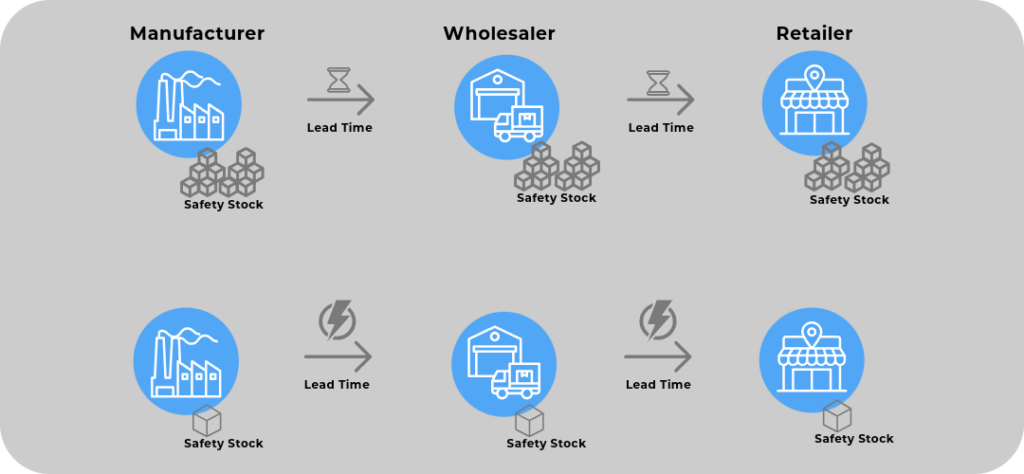
What is the Difference Between Single-Echelon and Multi-Echelon Inventory Optimization?
You might be wondering, “Why not just manage inventory at one level and call it a day?” That’s a single-echelon approach, where inventory management focuses on just one stage of the supply chain.
But in reality, your supply chain has multiple stages—like warehouses, distribution centers, and retail stores. That’s where multi-echelon optimization comes in. It takes a big-picture view, looking at every link in your supply chain and coordinating inventory management across all of them. This means considering things like demand variability, lead times, and stock availability at each stage to make sure you’re not holding too much inventory in one place and too little in another.
Multi-Echelon Inventory Management
Managing inventory in a multi-echelon system is about coordinating various moving parts. Imagine you have products stored in several warehouses across different regions. Instead of treating each warehouse separately, multi-echelon inventory management connects them all, ensuring that inventory moves efficiently between locations.
Key elements of multi-echelon inventory management include:
- Demand Forecasting: Understanding future demand is key to preventing stockouts or overstocking.
- Inventory Classification: Not all products are equal. Categorizing them based on their demand and importance helps tailor your stocking strategies.
- Reorder Point and Safety Stock: Setting smart reorder points and safety stock levels ensures you’re not caught off guard by sudden demand spikes.
- Lead Time Optimization: Faster replenishment processes mean fewer stockouts and less need for holding excess inventory. Manufacturing lead time measures how quickly a product can be produced and made available to customers
- Performance Measurement: Regularly tracking key metrics helps you fine-tune your inventory strategies over time.
The Importance of MEIO in Ecommerce
In ecommerce, where speed and accuracy are everything, MEIO can give you a competitive edge. Customer expectations for fast deliveries are higher than ever. No one wants to deal with an ‘out of stock’ message or delayed shipping. With MEIO, you can prevent these issues by making sure your inventory is well-distributed across your supply chain.
By keeping inventory optimized at every level, you’re not just improving your ability to fulfill orders quickly—you’re also cutting down on unnecessary holding costs and improving profitability.

Example of Multi-Echelon Optimization (MEIO)
Let’s say you run an ecommerce business selling electronics. You have two warehouses—one on the West Coast and one on the East Coast. Traditionally, you’ve managed these warehouses separately, keeping a set amount of stock in each location.
But what if demand surges on the West Coast while the East Coast inventory remains largely untouched? You might end up with excess stock sitting in the East while scrambling to fulfill orders from the West.
With MEIO, you can avoid this scenario. You could redistribute your inventory based on regional demand forecasts, moving products between locations as needed. If sales data shows that West Coast demand is expected to spike, you can proactively shift more stock there in advance, ensuring smooth operations without the stress of last-minute adjustments.
Pros and Cons of MEIO
MEIO isn’t a magic wand, but it offers some solid advantages. Here’s a quick look at the pros and cons:
Pros:
- Better Inventory Distribution: No more overstocking in one warehouse while another is understocked.
- Cost Efficiency: With optimized inventory levels, you save on holding and storage costs.
- Improved Customer Satisfaction: Having products where and when they’re needed translates into faster deliveries and happy customers.
- Data-Driven Decisions: MEIO uses demand forecasts, historical data, and trends to make smart inventory moves.
Cons:
- Complex Implementation: MEIO requires careful planning and continuous monitoring, which can be time-consuming.
- Technology Dependence: Implementing MEIO often requires advanced software solutions, which may come with additional costs and a learning curve.
- Data Accuracy: Relying on data-driven decisions means that inaccurate data can lead to poor outcomes.
Common Problems When Implementing MEIO
Like any strategy, implementing MEIO comes with its own set of challenges. Some common problems include:
- Inconsistent Data: MEIO relies heavily on accurate data for demand forecasting and inventory planning. Inconsistent or outdated data can throw off your entire system.
- Complex Supply Chains: The more complex your supply chain, the harder it can be to coordinate everything effectively. Misaligned processes between different stages can lead to inefficiencies.
- Change Management: Implementing MEIO often requires changes in processes and workflows, which can be met with resistance from teams not used to the new system.
But the good news? Software like Finale Inventory helps address many of these challenges by offering real-time data, seamless integrations, and easy-to-use tools for managing complex supply chains.
Setting Multi-Echelon Safety Stock Levels with Imperfect Data and Unpredictable Demand
When demand isn’t stable and data isn’t perfect, setting safety stock levels across multiple echelons in a supply chain can feel daunting. How do you ensure you have enough stock to meet demand without overstocking and tying up too much capital?
The key is first understanding what’s causing the variability. For instance, is the fluctuation seasonal, or is it something else? If you can identify a clear pattern, you may be able to adjust your inventory strategy to match that seasonality. However, if the demand pattern is inconsistent, a deeper analysis may be required.
There are multiple approaches to calculating safety stock, and not all of them are created equal. Choosing the right one depends on how your demand behaves and the cost implications of different methods. For instance, if you deal with high-value items that have long lead times or serious consequences for stockouts, you might need to invest in more conservative inventory models. On the other hand, if demand is fairly predictable with only occasional spikes, a simpler model may suffice.
In situations where demand patterns are difficult to predict, such as low-demand items with high variability, traditional methods may not work. In these cases, discrete distribution models or even tailored inventory strategies that treat different demand types separately might be needed.
Ultimately, the goal is to find an inventory optimization plan that fits your specific needs, whether that means building seasonal models, using more sophisticated forecasting techniques, or simply fine-tuning your current approach. Keeping both your internal team and your clients aligned on stocking strategies is crucial for success.
In short, while setting multi-echelon safety stock levels with imperfect data can be challenging, a thoughtful approach that considers the underlying causes of demand variability can help you create a more effective and cost-efficient inventory management system.
Setting Safety Stock for Unpredictable Demand and Constant Lead Time
Calculating safety stock can be tricky, especially when dealing with unpredictable demand and a constant lead time. Here’s a straightforward approach to get you started, but remember, real-world factors might require some adjustments.
Basic Calculation
Start by determining the safety stock based on your desired service level during the lead time. For example, if you aim for a 98% service level and your demand follows a normal distribution, you would calculate safety stock as 2 standard deviations above the expected demand for the lead time period.
Imagine you have a lead time of 10 days. If the expected demand over those 10 days is 5 units with a standard deviation of 3 units, you’d set your safety stock to cover up to 11 units (5 units + 2 * 3 units).
Real-World Adjustments
However, in practice, things aren’t always that straightforward:
- Lead Time Variability: Lead time is rarely consistent. Even if your supplier is reliable, the time between placing an order and receiving it can vary. If you order weekly but have a 10-day lead time, the effective lead time for safety stock calculations might range from 10 to 16 days. This variability should be factored into your safety stock calculations.
- Demand Distribution: Demand doesn’t always follow a normal distribution. For low-volume or irregularly ordered items, the actual demand might deviate significantly from your forecasts, making standard deviations and expected demand less reliable.
- Service Levels: The service level you aim for during the lead time isn’t the same as your overall service level. Stockouts can occur before reaching your reorder point or safety stock, so your safety stock settings might need to adjust based on the overall service level you’re targeting.
Given these complexities, a simulation-based model might be more effective for setting safety stock levels. Such models can account for variability in lead time and demand, providing a more nuanced approach to inventory management.
Enhancing Your Supply Chain with Finale Inventory: Managing Safety Stock and Multiple Locations
Navigating a complex supply chain with multiple warehouse locations and fluctuating demand can be challenging, but Finale Inventory makes it simpler. The platform helps you effectively manage safety stock by allowing dynamic calculations and automated adjustments based on real-time data and demand forecasts. This ensures you maintain optimal inventory levels without constant recalibration.
For businesses with multiple warehouses, Finale Inventory offers centralized inventory management, giving you a unified view of stock levels across all locations. Automated replenishment workflows streamline processes, and you can set location-specific safety stock levels and replenishment rules to meet the unique needs of each warehouse.
The platform also provides integrated reporting and analytics, helping you track performance and make informed decisions to enhance your supply chain efficiency. With Finale Inventory, you can better manage safety stock and coordinate across multiple locations, ensuring a smoother and more cost-effective inventory management process.
Transform Your Inventory with Finale
Request a Free consultation (valued at $2,500) and let us tackle solving your biggest inventory management challenges with Finale Inventory and experience the difference Finale Inventory can make for your business.
