


Select Page
Home 5 Inventory Management 5 Perpetual vs. Physical Inventory | Finale Inventory

Blog

Originally published on September 1, 2022 Last updated on March 6, 2026

Perpetual vs. Physical Inventory | Finale Inventory

Perpetual inventory systems and physical inventory systems attempt to keep businesses organized and provide them with data that can help them make accurate decisions and know the correct amount of available inventory. However, these different types of inventory systems achieve these goals through different means. What Is Perpetual Inventory? Perpetual inventory systems are methods of inventory […]
Warehouse workers stacking inventory

Perpetual inventory systems and physical inventory systems attempt to keep businesses organized and provide them with data that can help them make accurate decisions and know the correct amount of available inventory. However, these different types of inventory systems achieve these goals through different means.

What Is Perpetual Inventory?

Perpetual inventory systems are methods of inventory management that keep track of inventory in real-time. The automated process allows users to see an accurate inventory count as it automatically updates it when a product is sold or received. The system uses sales and purchasing records to keep track of the inventory.

To implement a perpetual inventory system, businesses need to have a point of sale (POS) system and inventory software integrated with that system so they can accurately and automatically track inventory. With these capabilities, the system will not require any manual data entry.

Running a perpetual inventory system allows companies to use unique accounting applications through which they can run the total cost of products sold and compare that to the total cost of the remaining inventory.

Perpetual inventory systems give businesses specific insight into where in the process individual units are. The system can track products from the time they are received from the manufacturer until they are delivered to a customer.

The cost of a perpetual inventory depends on the size of the business and how much technology they already have in place.

What Is Physical Inventory?

Physical inventory requires a person to count all the inventory a business has rather than using automation. The stock they count is known as the quantity on hand — the stock a company has physically available to distribute to customers. Physical inventory systems vary depending on what is best for a specific company.

Cycle counting is when businesses regularly check to see if their current inventory matches their records by counting the inventory on site. Companies can use pen and paper, mobile devices, or barcode scanners. Whatever method a business uses, counting requires human effort and is subject to human error. Finale Inventory offers cycle count software that helps businesses be efficient and accurate through the counting process.

A business’s physical inventory should be taken in all of its locations. Often inventory is held in several locations, and it is important not to forget any of them to avoid discrepancies.

Because there is less technology involved, physical inventory systems tend to run at a low cost but take more time.

How Are Perpetual Inventory and Physical Inventory Different?

Perpetual inventory and physical inventory seek to achieve the same end goal but do so very differently. Here are the most significant differences between these two systems.

Human Involvement

One major difference between perpetual inventory and physical inventory is the amount of human involvement they require. Perpetual inventory is automated and only requires human involvement for the initial setup. Meanwhile, physical inventory requires humans to count the inventory repeatedly and then analyze and implement the data. 

Cost

Perpetual inventory systems are more expensive upfront because of the necessary technology. Physical inventory systems are lower cost upfront but require employees to take on added responsibilities by manually counting the inventory according to the schedule, increasing costs over time. 

Speed

An automatic process is naturally going to be faster than human processes. If speed is a concern for a business due to the size of its inventory compared to the number of employees, a perpetual inventory system may be the right solution.

Accuracy

Data from a perpetual inventory system may not be as accurate as data from a physical inventory system because of its scope and how quickly it tracks items. However, physical inventory systems are also subject to inaccuracy simply due to human error that goes unchecked, but a well-thought-out and organized system may lead to fewer errors than a perpetual inventory system.

Size of Organization

Another difference between physical and perpetual inventory systems is the size of the organization they can cover. Physical inventories are generally better for smaller businesses. Bigger companies may have a harder time implementing physical inventory systems but could if they are willing to hire extra help. Businesses of any size can use perpetual inventories since they can track large amounts of data and scale with a growing company.

How to Choose the Best Inventory Method for Your Business
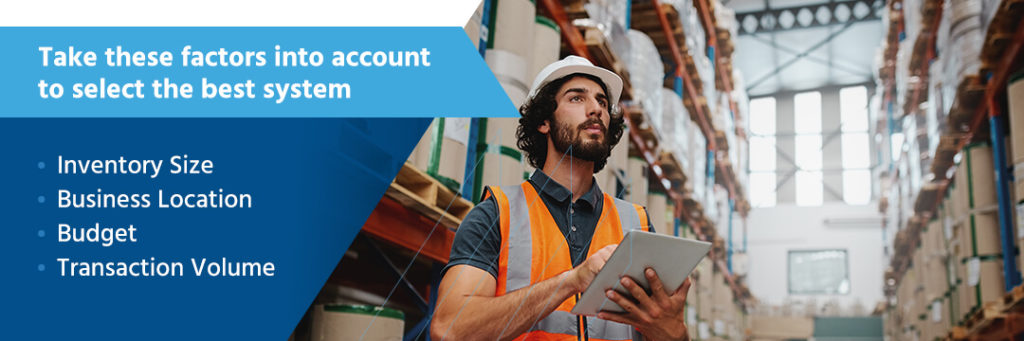
Businesses should consider various aspects of their workflow when choosing an inventory method. Take these factors into account to select the best system for your company:

Inventory Size

Businesses should find the current size of their inventory and project what will change and how big it will get in the near future. A physical inventory system is best for a small inventory, as it will be less difficult for those counting. If a business has a large inventory or is growing, a perpetual inventory system can improve its efficiency.

Business Location

If a business has multiple locations, they should determine whether they are willing to risk missing or double-counting inventory if they choose a physical inventory system. A perpetual inventory system can track inventory between sites and share that data between the sites as well. 

Budget

Companies should consider their budget and determine whether they would like to pay more upfront or less upfront but more over time. A perpetual inventory system will cost more initially, while a physical inventory system will be cheaper at first but may require continual financial investment.

Transaction Volume

Businesses that deal with many daily transactions should consider an automated process to avoid errors. If a company like this chooses a physical inventory system, it may cause more strain since employees will need to count inventory more often. A business with a small number of daily transactions could lean towards a physical inventory system.
Streamline Your Operations With Finale Inventory Management Software

Finale Inventory offers solutions that will help you get the inventory system you need. Schedule a demo today to see exactly how our services would integrate into your workflow before you purchase. If you have any questions or concerns, please call us at 888-792-8891 or fill out our contact form and a member of our team will be with you as soon as possible.

“The core of maturity, that I see, is starting with a unified view of inventory. I’ve got to be able to accurately represent what do I have, make sure that I know where it’s located so I can get it to my customers quickly.”

— Troy Graham, Descartes

What is the first thing I should fix if I want to scale operations?

Start with a unified view of inventory. The core of maturity starts with being able to accurately represent what you do have and make sure that you know where it’s located to get it to customers quickly. Without a unified view across your warehouses, 3PLs, and vendors, you cannot make the best decisions because you don’t have the best information at hand.

With Inventory Visibility, Businesses Can Make Smarter Allocation Decisions

Once inventory is centralized, businesses can move from reactive updates to intentional allocation. They can decide how much inventory to expose to each channel, when to use buffers, which marketplaces need extra protection, and how seasonality or campaign performance influence availability.

Once I know what inventory I have, how should I decide where to make it available?

Inventory allocation should reflect where orders are coming from, where marketing is working, and which channels carry the most risk. Once you know what you have and where it is located, you can think more strategically using centralized inventory to make prioritization happen automatically. One fertilizer company lost a little over 5,000 orders in one weekend because someone manually uploaded the wrong available inventory to Amazon.

Better Inventory Data Improves Planning, Purchasing, and Growth Bets

Better visibility turns inventory data into a planning tool. With insight into sales velocity, inventory levels, vendors, and channel performance, businesses can make more informed replenishment decisions, avoid overbuying, and test new product lines or vendor-supplied inventory without taking on unnecessary risk.

“You have to have unified inventory to know how to price your products just at that basic level. I can’t price my products if I don’t know the true cost to get it.”

— Mike Bernico, Flxpoint

How does better inventory data help me make smarter buying decisions?

It lets you measure whether your plan is working before you commit more capital. A key question becomes: “Did my plan work? Am I overleveraged in one place or another?” Centralized systems can also help businesses test new product lines or vendor relationships by looking at sales velocity by channel, allowing them to take risks in a calculated and measured way.

Intelligent Order Routing Turns Inventory Complexity Into Automation

Once inventory and supplier data are reliable, businesses can automate fulfillment decisions. Orders can be routed based on cost, speed, margin, location, warehouse priority, vendor fallback, split-shipment rules, or customer expectations. This helps hybrid fulfillment scale because every order does not need a manual review.

How do I decide the best way to fulfill each order?

There is no single answer, which is why order routing needs to account for the context of each order. Intelligent order routing is not just sending an order to someone who has stock; it is taking each and every order and treating it like its own unique use case. Depending on the order, the business may prioritize speed, margin, an internal warehouse, vendor fallback, or preventing split shipments.

Supplier Inventory Sync Extends Inventory Beyond the Four Walls

For hybrid fulfillment to work, supplier inventory needs to become part of the operating model. Supplier sync does not always require advanced technology; it can happen through automated files, FTP, email, APIs, EDI, or ecommerce storefront integrations. The key is replacing manual updates with automated, reliable supplier data.

Can supplier inventory really be treated like part of my own inventory?

Yes, but the goal is not necessarily to force every supplier into a complex integration. Real-time supplier sync can be defined as any way to get an automated update from a supplier, such as Google Sheets, email, FTP, API, EDI, or ecommerce storefront connections. The key is that accurate supplier stock is foundational. If you don’t have an accurate view of what is in stock with your suppliers, you cannot tell your sales channel accurately what’s available.

Exception-Based Workflows Keep Humans Focused Where They Matter

Automation does not remove people from the process. Mature operations let technology handle the routine majority while humans focus on exceptions, such as high-value orders, fraud risk, compliance requirements, restricted products, export rules, or unusual fulfillment scenarios.

If my business has special cases, can automation still work?

Yes. The point is not to automate every possible decision; it is to automate the routine work and surface the exceptions. Businesses should not have to look at every single order. Instead, technology can highlight high-value orders, risky locations, or compliance requirements. The goal is to take care of the 80% of workflows that are obvious while still allowing human review when specific exceptions arise.

The Right Inventory Technology Should Fit the Business, Not Overwhelm It

Software decisions should be based on business fit, not popularity, feature volume, or broad “all-in-one” promises. Growing ecommerce businesses should identify their highest-impact bottleneck, prioritize what matters now, and choose technology that is right-sized but flexible enough to support future phases of growth.

How should I choose software without overbuying or picking the wrong system?

Start with your priorities, not the biggest feature list. Avoid an all-in-one system that claims to “do everything under the sun” and look for a “best of breed approach” with systems that can scale as you add channels or vendors. The practical advice is to stack rank what matters now, make sure the system can support future phases, and choose technology that fits your business rather than overwhelming it.

How to Scale Ecommerce Operations Beyond Spreadsheets

For many growing ecommerce businesses, Finale and Flxpoint work together as a practical answer to these challenges. Finale helps centralize and manage internal inventory, purchasing, warehouse operations, and stock visibility, while Flxpoint helps connect vendor inventory, automate supplier sync, and route orders across hybrid fulfillment networks. Together, they give businesses a best-of-breed way to improve inventory accuracy, reduce spreadsheet work, and scale fulfillment without forcing every process into a one-size-fits-all system.

Ecommerce Fulfillment Operations FAQ

What Is Ecommerce Fulfillment Operations?

Ecommerce fulfillment operations are the processes that move an online order from purchase to delivery. This includes managing inventory, syncing product availability across channels, routing orders to the right warehouse, 3PL, supplier, or vendor, and making sure the customer receives the right product on time. As discussed in the webinar, fulfillment is no longer limited to “what’s in my warehouse these days”; growing businesses may rely on internal warehouses, 3PLs, marketplace fulfillment services, and supplier inventory at the same time.

What Are Ecommerce Fulfillment Operation Examples?

Examples of ecommerce fulfillment operations include updating inventory across Shopify, Amazon, Walmart, and other sales channels; allocating inventory to specific marketplaces; sending orders to an internal warehouse, 3PL, or vendor; syncing supplier inventory through files, APIs, EDI, email, or FTP; replenishing warehouse stock based on sales velocity; and flagging exceptions such as high-value orders, compliance requirements, or restricted products. In the webinar, the speakers also discussed hybrid fulfillment examples where a business may fulfill some products from its own warehouse and use vendors as a fallback or extension of available inventory.

How Can I Track My Inventory at an Ecommerce Fulfillment Center?

The best way to track inventory at an ecommerce fulfillment center is to create a unified inventory view that shows what is available, where it is located, and how that inventory connects to each sales channel. That means tracking inventory across internal warehouses, fulfillment centers, 3PLs, marketplace fulfillment programs, and supplier locations instead of relying on disconnected spreadsheets. The webinar emphasized that businesses need to “accurately represent” what they have and know where it is located so they can get products to customers quickly.

How Can I Connect My Inventory to My Supplier?

You can connect supplier inventory through several methods, depending on what the supplier supports. The webinar discussed low-tech and advanced options, including automated Excel or CSV files, Google Sheets, email updates, FTP servers, APIs, EDI, and direct connections to ecommerce storefronts such as Shopify, BigCommerce, or Magento. The key is to ask suppliers how they share inventory today, then use a system that can automate that data flow instead of manually copying supplier inventory into spreadsheets.

What Is Ecommerce Order Routing?

Ecommerce order routing is the process of deciding where an order is fulfilled from after a customer buys. In a simple operation, every order may go to one warehouse. In a more complex or hybrid fulfillment model, the best fulfillment source may depend on inventory availability, shipping speed, cost, margin, customer location, warehouse priority, vendor fallback rules, or whether the order should be split. The webinar described intelligent order routing as treating each order like its own use case, so businesses can automate the best fulfillment decision without manually reviewing every order.

Keep Up With the Latest From Finale

All the inventory tips, trends, best practices, news, and insights you need, delivered straight to your inbox.

Subscribe to Our Newsletter