
Sales velocity — a measurement of revenue speed and volume — is a valuable measurement for your e-commerce business.
From indicating your business’s health to helping you calculate your reordering points, sales velocity in the e-commerce industry can measure your status and show you how to improve. But how do you calculate it, and how can you increase it? To answer those questions, it’s best to start with the basics.
What Is Sales Velocity?
Your company’s sales velocity is a measurement of how much revenue it makes in a day. It tells you the speed at which deals move through your sales pipeline, taking your audience from potential customers to purchasers.
Why measure sales velocity? Crunching these numbers can help you assess your business’s overall well-being. Compare your results before, during, and after a marketing campaign. Did the ads bring in new customers? If so, how many of them did you retain after the push was over? Knowing your sales velocity allows you to evaluate your methods for maintaining customer loyalty and maximizing conversions.
Keep an eye on your numbers and compare them over time. Note if and when they trend upward, and use that information to evaluate potential weak spots in your pipeline.
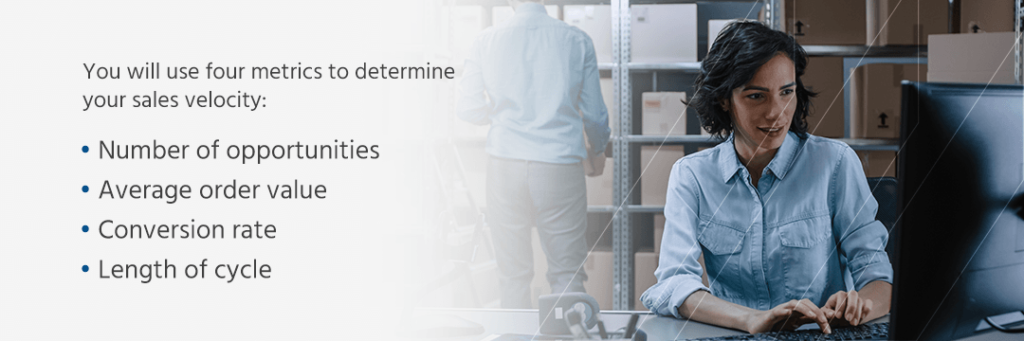 You will use four metrics to determine your sales velocity.
- Number of opportunities: Typically, salespeople define opportunities as qualified leads, or the leads most likely to lead to conversions. For sales velocity in the e-commerce industry, your number of opportunities is the total number of visitors to your website within the defined timeframe.
- Average order value: Average how much money customers spend on your site to determine your average order value.
- Conversion rate: Your conversion rate is the percentage of your site’s total visitor count that made a purchase.
- Length of cycle: The cycle is the amount of time you would like to evaluate. You can measure your velocity over any length of time, though you may be able to spot potential areas of improvement by studying shorter periods. Choose the time you would like to review and use the total number of days to calculate your daily revenue.
With those metrics in mind, what is a good sales velocity? The answer will depend on several factors, like your organization’s size and reach. While it might be easier to have an industry baseline to reference, the best benchmark for your company’s success is your past performance. If your sales velocity is trending upward, you should be on the right track. However, be wary of focusing on the final number without paying attention to the individual metrics. Are you retaining enough opportunities to maintain your velocity? Is your average order value skewing upward because a small number of customers have made expensive purchases? To get the full picture this metric offers, it’s vital to study the individual parts beside the whole. To do so, you’ll need to know how to calculate sales velocity.
How Do You Calculate Sales Velocity?
The typical sales velocity equation is your number of opportunities multiplied by your average order value multiplied by your conversion rate, all divided by the length of your cycle. In other words:
Number of Opportunities × Average Order Value × Conversion Rate / Length of Cycle = Sales VelocityYou can see how the metrics come together in this equation. But where do the numbers come from?
Number of Opportunities
In e-commerce, your opportunities are the total number of people who visited your site within a given period. Several tools are available to help you monitor your traffic, from free applications to paid services. If you’re calculating your sales velocity in total, you’ll want to include all the traffic your site has generated in this metric.
Using tools that let you correlate your sales data with your site’s different traffic sources can give you more specific numbers. By limiting your pool to the traffic from a particular source, you can track your sales velocity for that source alone. You can use that information to target your traffic generation strategies more effectively. You may also have multiple online storefronts. Using an e-commerce inventory management system to track your sales data will allow you to individually monitor your sales velocity for each storefront.
Average Order Value
Your average order value is the only sales velocity metric that directly corresponds to profits and is likely the most straightforward data to find. To calculate your business’ average order value, divide your total revenue by the number of purchases made during your designated timeframe.
If you’re evaluating the success of your recent marketing campaign or sale, choose a period that doesn’t include that event for comparison. Calculating your average order value before, during and after will allow you to put the event into context.
Conversion Rate
Of the people who visited your site, how many made a purchase? You can find your conversion rate by dividing the number of times someone bought something on your site by the number of visitors. Your conversion rate can be a valuable indicator of your site’s health, even on its own. You can use this metric to see how well you’re targeting your advertising and which sources generate the highest purchasing traffic levels. While 10% is a good overall conversion rate for your site, the numbers vary by channel. Reviewing which channels return the highest rate will indicate where to direct your efforts for the best returns.
Length of Sales Cycle
Traditional sales industries, and even brick-and-mortar retailers, have very structured sales cycles. Those begin with identifying qualified customers and continue through contact, to making an offer, to fully closing the deal. It’s more challenging to track those stages in e-commerce, where you’re unlikely ever to have direct contact with the customer unless you’re resolving an issue. Because of that, when calculating sales velocity, your sales cycle’s length is the timespan that you choose.
The timeframe you evaluate is the only one of the four sales velocity metrics directly under your control. Which block of time you choose to study will depend on what information you’re looking for. A wider spread of time will give you a more general overview, while a narrower one will deliver more specific information.
Why Is Sales Velocity Important?
Achieving higher sales velocities means your business is bringing in more revenue faster. While it’s valuable to know that for anyway, there are also deeper reasons to measure sales velocity.
1. Evaluate Your History
Tracking your sales velocity over time gives you a bird’s-eye view of your pipeline.
If the pipeline is a river, your different channels are its tributaries, and your traffic sources are the creeks and streams that form them. Your sales velocity shows you which channels are contributing the most. It lets you see if a new process or redesign widened a tributary or dammed it up.
Comparing your velocity across several different sales cycles will also help you establish your business’ baseline. Once you have that, you’ll have a more accurate sense of when you improve.
2. Fine-Tune Your Process
When you know which of your processes are working and which ones aren’t, you can start making adjustments.
The higher your sales velocity, the higher your inventory turnover. Is your velocity for a specific item particularly low? That could mean that you’re paying to store excess stock of something that isn’t selling well, eating into your profits. By better understanding your sales velocity, you can more accurately order inventory with a high turnover rate.
Conversely, if you can identify items in your inventory with high sales rankings, you can use that to boost their sales even further. Customers see high sales numbers as endorsements for an item’s quality. Advertising top-rated products makes your customers more likely to buy those items.
3. Improve Your Customer Experience
As an e-commerce business, your sales velocity’s significance lies in is its ability to give your customers a better shopping experience. Analyzing your pipeline lets you find places where you may be losing customers. If your traffic has increased, but your conversion rate has dipped, something about your site may make it tricky for customers to complete a purchase. If you heavily promoted specific products, then ran out of inventory, people may have left when they saw those items were out of stock. Familiarizing yourself with your pipeline velocity is essential if you want to convert as many of your opportunities into customers as possible. Look for your potential areas of improvement, and when you find one, act immediately to solve it.
How to Improve Sales Velocity
Now that you’ve figured out whether you’re losing opportunities or where your process is slowing down in the pipeline, you can take steps to improve. The key to an increased sales velocity lies in rebalancing the metrics. Increased traffic, a higher conversion rate and a higher average order value will all give boosts to your velocity.
Increase Your Traffic
- Create product combos: Make listings for product kits or bundles — multiple products purchased together. The bundle is typically available for a lower price than buying each item individually to appeal to customers who may not otherwise have bought the products separately.
- Build customer loyalty programs: For example, customers might receive coupons for $25 off a later purchase of $50 or more for every $50 they spend. By tying their future savings to their current spending, customers are more likely to make larger purchases.
- Set minimum order incentives: Free shipping and coupons are examples of compelling minimum order incentives. You might offer free samples with every purchase that reaches a specific amount. You can even tie a minimum order to a direct discount by offering increased discounts depending on the purchase size.

Let Finale Inventory Help Increase Your Sales Velocity
In the e-commerce industry, sales velocity is vital, but keeping track of all the moving parts can be complicated. Whatever the size or scope of your business, Finale Inventory has the tools to help you reach your full potential.
Finale’s inventory management system is fast, scalable, and adaptable to your needs. See how Finale can help your ecommerce business, schedule a demo today!
There are dozens of ways to drive more traffic to your site. For example:
- Promotional events like coupons and flash sales
- Paid advertising
- Social media ad campaigns
- SEO and keyword research
However, if increasing your sales velocity is the goal, you need a more focused approach. Instead of trying to increase your total traffic, work on boosting traffic from your target audience. Your target audience is the portion of your potential customers most likely to purchase from your website — the users most likely to bump up your conversion rate.
You probably already have a good idea of your customer demographics. Psychographics can help create a more complete picture of your potential audience by showing you their areas of interest, hobbies and opinions. You can gather some of that information through your website analytics, but you can also use social media, surveys, quizzes or questionnaires.
Once you’ve identified your target audience, you can focus your efforts on encouraging them to visit your site. What platforms do they use most often? What incentives are most likely to draw them in? What sales approach do they respond to best? Remember, a smaller audience that buys more is better than a larger audience that buys little.
Improve Your Conversion Rate
An increase in targeted traffic will certainly help, but your audience may still need additional incentives to move from users to customers. The first and most critical step to improve your conversion rate is to ensure the best possible user experience. Ensure the pages across your site load quickly and cleanly, and use high-quality images for all your products. Mobile traffic accounts for over 50% of total online traffic worldwide, so optimize your site for mobile use.If you have your inventory listed across multiple storefronts, there may be a lag between when a popular item sells out and when you can change the listing to reflect that. A user who buys something, only to receive a message that their purchase is out of stock, is likely to view that as a black mark against the site. The resulting disappointment will make them unlikely to purchase something else in its place and even less likely to return to your store. Using inventory management software integrations will allow you to accurately reflect your stock across different storefronts and platforms.
However, if you’re looking for the easiest way to increase conversion, the answer is simple — free shipping. You will need to strike a balance between conversion and order value to maintain your profits, but it’s indisputable that free shipping increases conversion rates.
Increase Your Average Order Value
The final metric may seem obvious. After all, how do you increase the amount of money your business makes in a day? Increase the average amount that customers spend! But how do you do that? Once again, inventory management software can be a significant help. With an easily accessed sales history, you can compare your sales at different times and look for patterns. Is there a product that always seems to be out of stock because customers snap up your new inventory almost immediately? Are there listings that only move seasonally but fly out of the warehouse then? Having what your users want when they want it increases the likelihood they’ll buy. Consider these other ways to increase your average order.
- Create product combos: Make listings for product kits or bundles — multiple products purchased together. The bundle is typically available for a lower price than buying each item individually to appeal to customers who may not otherwise have bought the products separately.
- Build customer loyalty programs: For example, customers might receive coupons for $25 off a later purchase of $50 or more for every $50 they spend. By tying their future savings to their current spending, customers are more likely to make larger purchases.
- Set minimum order incentives: Free shipping and coupons are examples of compelling minimum order incentives. You might offer free samples with every purchase that reaches a specific amount. You can even tie a minimum order to a direct discount by offering increased discounts depending on the purchase size.
Let Finale Inventory Help Increase Your Sales Velocity
In the e-commerce industry, sales velocity is vital, but keeping track of all the moving parts can be complicated. Whatever the size or scope of your business, Finale Inventory has the tools to help you reach your full potential.
Finale’s inventory management system is fast, scalable, and adaptable to your needs. See how Finale can help your ecommerce business, schedule a demo today!
[/et_pb_text][/et_pb_column][/et_pb_row][/et_pb_section]