


Select Page
Home 5 Product News 5 How to Sell Consumer Electronics Online

Blog

Originally published on February 11, 2022 Last updated on March 6, 2026

How to Sell Consumer Electronics Online

If you have consumer electronics to sell, you need to know a few points about the industry to be as successful as possible.  The first is the high competition in the consumer electronics industry. Consider all of the companies that have major shares in the electronic industry. Apple and Samsung are perfect examples, selling a […]
How to sell consumer electronics online

If you have consumer electronics to sell, you need to know a few points about the industry to be as successful as possible. 

The first is the high competition in the consumer electronics industry. Consider all of the companies that have major shares in the electronic industry. Apple and Samsung are perfect examples, selling a broad range of products that come out in new models each year. Therefore, anyone getting into online consumer electronic sales should get started on the right foot.

The second point to remember is that if you’re planning on selling any consumer electronics, your best bet is to sell them online. A consumer electronics e-commerce store is your opportunity to stay relevant in the industry. Through e-commerce, you’ll be able to reach as many people as possible without spending resources on a brick-and-mortar storefront. At least to start out, e-commerce is the best way to go.

Some other points you need to consider before starting selling consumer electronics online include:

  • How are you going to get your products? Are you going to buy them wholesale or from a specific retailer?
  • How are you going to ship your products? Do you have the right resources to support your delivery process? With consumer electronics, you must choose your shipping options carefully.
  • How are you going to reach your customers? Will you be using any marketing channels to get your consumer electronics to your target audience?

Once you take the time to figure out your processes, you’ll have a better understanding of what you need to begin with when selling consumer electronics products online.
What Consumer Electronics Can You Sell?

If you need any ideas on what electronics to sell, you can consider a few of the following ideas:

  • Smart home: These products are designed to make people’s lives easier. An example would be Amazon Alexa, which has more than one smart capability that makes it more convenient for users. Alexa can answer questions, turn lights on and off, set reminders and play music — just to name a few capabilities. Overall, smart home products are only advancing, making them a perfect electronic item to sell on your online store.
  • Computers: Whether for work, school or entertainment, millions of people use computers, and will continue to do so for the foreseeable future. Consider stocking your e-commerce store with laptops, desktops and computer accessories like keyboards and mouses.
  • Personal devices: These are products such as tablets, headphones, smartwatches and smartphones.
  • Electronic parts: Some people don’t purchase new computers or other electronics when they break. Instead, they find the parts to replace them. This could be a great market, especially if you tap into one niche, like keyboard switches and caps. Some sellers also find success by offering electronic components such as resistors, capacitors, and circuit boards, which appeal to DIY tech enthusiasts and repair professionals alike.

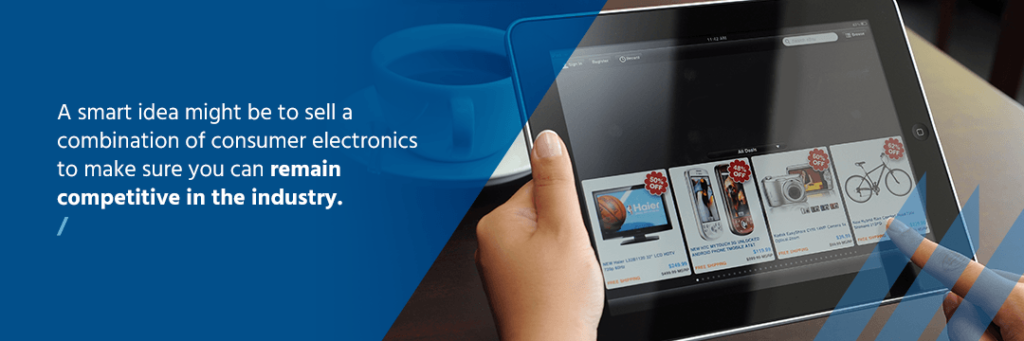
A smart idea might be to sell a combination of consumer electronics to make sure you can remain competitive in the industry.

Where Can You Start Selling Electronics Online?

Now, you need a way to sell your products. If you’re concentrating on the e-commerce market, you have numerous options to consider. Try the following:

  • Website: For complete control over your products and sales, you may want to build your own website. For a simple e-commerce website, you could use platforms like Shopify or Wix. Note that with such platforms, you don’t own the website and might have a few restrictions with layout and functions. Another option would be to use WordPress or WooCommerce. The disadvantage here is that they’re more technical and could have higher costs.
  • Amazon: If you want to prioritize high sales and reach the right audience, you can sell your consumer electronics on Amazon. Nearly everyone has used Amazon services at some point. The advantage of selling on Amazon is reaching many potential customers worldwide, having Amazon take care of some of the logistics and not needing to build a website. However, the central disadvantage is that there are selling fees involved with each sale. This cost decreases your profit margin, which is already low due to the competition in the industry.
  • eBay: ebay is one of the most notable names in the reselling game, meaning you have the chance to reach millions of people worldwide. Similar to Amazon, there are fees that decrease your profit margin. Additionally, if you’re looking to sell new consumer electronics, it can be challenging to get buyers to purchase a new item over a used one, especially when it comes to computers. That said, using eBay in tandem with another selling platform could be beneficial.
  • Facebook Marketplace: Facebook Marketplace is a quick, simple way to sell consumer electronics to people in your area. A key benefit is the platform’s ability to integrate with Facebook, Instagram, WhatsApp and Messenger Ads. Some sellers only sell on Facebook because of its connectivity. The main downside to Facebook is that you mainly have to speak directly with buyers.
  • Walmart Marketplace: This is a great option that’s much less saturated than other similar platforms. With Walmart Marketplace, you can easily list all of your products and be able to reach many consumers. However, one disadvantage is they take referral commissions from every transaction.

It’s important to take time to understand which one might be the best option for you based on your goals. While you may start selling on one of the above platforms, you’ll likely eventually want to expand your business and sell your products using more than one of them. If you’re uninterested in starting your own website now, you should start with one of the marketplaces to begin. Then, you can always create a website once you’ve established your company’s brand identity.

Choose Finale Inventory’s E-Commerce Inventory Management Products

If you’re selling consumer electronics, you likely have an extensive inventory. To keep track of your sales data, turn to Finale Inventory’s multichannel inventory management software. With our software, all of your product and sales information is available in one place, meaning you can streamline processes from day one. Additionally, Finale Inventory integrates with more than 40 point-of-service and e-commerce sales channels for improved accessibility.

Whether you sell on your website or through online marketplaces, you can keep track of your inventory stock with a single software. Learn more about our software and how you can start taking advantage of it today. Start by scheduling a demo or requesting a free 14-day trial.

“The core of maturity, that I see, is starting with a unified view of inventory. I’ve got to be able to accurately represent what do I have, make sure that I know where it’s located so I can get it to my customers quickly.”

— Troy Graham, Descartes

What is the first thing I should fix if I want to scale operations?

Start with a unified view of inventory. The core of maturity starts with being able to accurately represent what you do have and make sure that you know where it’s located to get it to customers quickly. Without a unified view across your warehouses, 3PLs, and vendors, you cannot make the best decisions because you don’t have the best information at hand.

With Inventory Visibility, Businesses Can Make Smarter Allocation Decisions

Once inventory is centralized, businesses can move from reactive updates to intentional allocation. They can decide how much inventory to expose to each channel, when to use buffers, which marketplaces need extra protection, and how seasonality or campaign performance influence availability.

Once I know what inventory I have, how should I decide where to make it available?

Inventory allocation should reflect where orders are coming from, where marketing is working, and which channels carry the most risk. Once you know what you have and where it is located, you can think more strategically using centralized inventory to make prioritization happen automatically. One fertilizer company lost a little over 5,000 orders in one weekend because someone manually uploaded the wrong available inventory to Amazon.

Better Inventory Data Improves Planning, Purchasing, and Growth Bets

Better visibility turns inventory data into a planning tool. With insight into sales velocity, inventory levels, vendors, and channel performance, businesses can make more informed replenishment decisions, avoid overbuying, and test new product lines or vendor-supplied inventory without taking on unnecessary risk.

“You have to have unified inventory to know how to price your products just at that basic level. I can’t price my products if I don’t know the true cost to get it.”

— Mike Bernico, Flxpoint

How does better inventory data help me make smarter buying decisions?

It lets you measure whether your plan is working before you commit more capital. A key question becomes: “Did my plan work? Am I overleveraged in one place or another?” Centralized systems can also help businesses test new product lines or vendor relationships by looking at sales velocity by channel, allowing them to take risks in a calculated and measured way.

Intelligent Order Routing Turns Inventory Complexity Into Automation

Once inventory and supplier data are reliable, businesses can automate fulfillment decisions. Orders can be routed based on cost, speed, margin, location, warehouse priority, vendor fallback, split-shipment rules, or customer expectations. This helps hybrid fulfillment scale because every order does not need a manual review.

How do I decide the best way to fulfill each order?

There is no single answer, which is why order routing needs to account for the context of each order. Intelligent order routing is not just sending an order to someone who has stock; it is taking each and every order and treating it like its own unique use case. Depending on the order, the business may prioritize speed, margin, an internal warehouse, vendor fallback, or preventing split shipments.

Supplier Inventory Sync Extends Inventory Beyond the Four Walls

For hybrid fulfillment to work, supplier inventory needs to become part of the operating model. Supplier sync does not always require advanced technology; it can happen through automated files, FTP, email, APIs, EDI, or ecommerce storefront integrations. The key is replacing manual updates with automated, reliable supplier data.

Can supplier inventory really be treated like part of my own inventory?

Yes, but the goal is not necessarily to force every supplier into a complex integration. Real-time supplier sync can be defined as any way to get an automated update from a supplier, such as Google Sheets, email, FTP, API, EDI, or ecommerce storefront connections. The key is that accurate supplier stock is foundational. If you don’t have an accurate view of what is in stock with your suppliers, you cannot tell your sales channel accurately what’s available.

Exception-Based Workflows Keep Humans Focused Where They Matter

Automation does not remove people from the process. Mature operations let technology handle the routine majority while humans focus on exceptions, such as high-value orders, fraud risk, compliance requirements, restricted products, export rules, or unusual fulfillment scenarios.

If my business has special cases, can automation still work?

Yes. The point is not to automate every possible decision; it is to automate the routine work and surface the exceptions. Businesses should not have to look at every single order. Instead, technology can highlight high-value orders, risky locations, or compliance requirements. The goal is to take care of the 80% of workflows that are obvious while still allowing human review when specific exceptions arise.

The Right Inventory Technology Should Fit the Business, Not Overwhelm It

Software decisions should be based on business fit, not popularity, feature volume, or broad “all-in-one” promises. Growing ecommerce businesses should identify their highest-impact bottleneck, prioritize what matters now, and choose technology that is right-sized but flexible enough to support future phases of growth.

How should I choose software without overbuying or picking the wrong system?

Start with your priorities, not the biggest feature list. Avoid an all-in-one system that claims to “do everything under the sun” and look for a “best of breed approach” with systems that can scale as you add channels or vendors. The practical advice is to stack rank what matters now, make sure the system can support future phases, and choose technology that fits your business rather than overwhelming it.

How to Scale Ecommerce Operations Beyond Spreadsheets

For many growing ecommerce businesses, Finale and Flxpoint work together as a practical answer to these challenges. Finale helps centralize and manage internal inventory, purchasing, warehouse operations, and stock visibility, while Flxpoint helps connect vendor inventory, automate supplier sync, and route orders across hybrid fulfillment networks. Together, they give businesses a best-of-breed way to improve inventory accuracy, reduce spreadsheet work, and scale fulfillment without forcing every process into a one-size-fits-all system.

Ecommerce Fulfillment Operations FAQ

What Is Ecommerce Fulfillment Operations?

Ecommerce fulfillment operations are the processes that move an online order from purchase to delivery. This includes managing inventory, syncing product availability across channels, routing orders to the right warehouse, 3PL, supplier, or vendor, and making sure the customer receives the right product on time. As discussed in the webinar, fulfillment is no longer limited to “what’s in my warehouse these days”; growing businesses may rely on internal warehouses, 3PLs, marketplace fulfillment services, and supplier inventory at the same time.

What Are Ecommerce Fulfillment Operation Examples?

Examples of ecommerce fulfillment operations include updating inventory across Shopify, Amazon, Walmart, and other sales channels; allocating inventory to specific marketplaces; sending orders to an internal warehouse, 3PL, or vendor; syncing supplier inventory through files, APIs, EDI, email, or FTP; replenishing warehouse stock based on sales velocity; and flagging exceptions such as high-value orders, compliance requirements, or restricted products. In the webinar, the speakers also discussed hybrid fulfillment examples where a business may fulfill some products from its own warehouse and use vendors as a fallback or extension of available inventory.

How Can I Track My Inventory at an Ecommerce Fulfillment Center?

The best way to track inventory at an ecommerce fulfillment center is to create a unified inventory view that shows what is available, where it is located, and how that inventory connects to each sales channel. That means tracking inventory across internal warehouses, fulfillment centers, 3PLs, marketplace fulfillment programs, and supplier locations instead of relying on disconnected spreadsheets. The webinar emphasized that businesses need to “accurately represent” what they have and know where it is located so they can get products to customers quickly.

How Can I Connect My Inventory to My Supplier?

You can connect supplier inventory through several methods, depending on what the supplier supports. The webinar discussed low-tech and advanced options, including automated Excel or CSV files, Google Sheets, email updates, FTP servers, APIs, EDI, and direct connections to ecommerce storefronts such as Shopify, BigCommerce, or Magento. The key is to ask suppliers how they share inventory today, then use a system that can automate that data flow instead of manually copying supplier inventory into spreadsheets.

What Is Ecommerce Order Routing?

Ecommerce order routing is the process of deciding where an order is fulfilled from after a customer buys. In a simple operation, every order may go to one warehouse. In a more complex or hybrid fulfillment model, the best fulfillment source may depend on inventory availability, shipping speed, cost, margin, customer location, warehouse priority, vendor fallback rules, or whether the order should be split. The webinar described intelligent order routing as treating each order like its own use case, so businesses can automate the best fulfillment decision without manually reviewing every order.

Ready to Take Control of Your Inventory?

Improve inventory, warehouse, and ecommerce operations today.

Request a Demo

Ready to Take Control of Your Inventory?

Improve inventory, warehouse, and ecommerce operations today.

Subscribe to Our Newsletter