Home5Product News5Kitting and Bundling Best Practices for the Health and Beauty Industry
Blog
Originally published on April 20, 2022
Kitting and Bundling Best Practices for the Health and Beauty Industry
Determining how to best sell your health and beauty products is a great first step toward increasing your sales and improving your overall business practices. Kitting and bundling let your company create interesting product offers that excite customers and benefit your business. Great deals make shoppers more likely to continue buying from you. When you sell products, […]
Determining how to best sell your health and beauty products is a great first step toward increasing your sales and improving your overall business practices. Kitting and bundling let your company create interesting product offers that excite customers and benefit your business.
Great deals make shoppers more likely to continue buying from you. When you sell products, you want your customers to feel like they’re getting the most value for their money.
Shoppers also make the best connections with brands that value their interests and provide enticing offers to encourage repeat purchases. Whether customers are shopping for specific items or browsing to try something new, they want to know your company will provide a range of interesting options to choose from.
Kitting and Bundling
Product bundling, or kitting, involves combining several complementary products into one unit, letting customers find all of the products under one listing. While you can still maintain individual listings, kitting and bundling helps sell more products by enticing buyers to purchase items as pairs or sets for lower prices than they would pay for each product individually.
Product bundles also encourage people to buy more than they initially planned. When shoppers see a deal that will save them money in the long run, they often spend more upfront than they would if they purchased the items one at a time.
Kitting and Bundling Best Practices for Health and Beauty Industries
Proper planning is essential for selling personal care and beauty products through kitting and bundling. As you market your existing products in a new light, you’ll need strategies specifically tailored toward creating appealing product bundles.
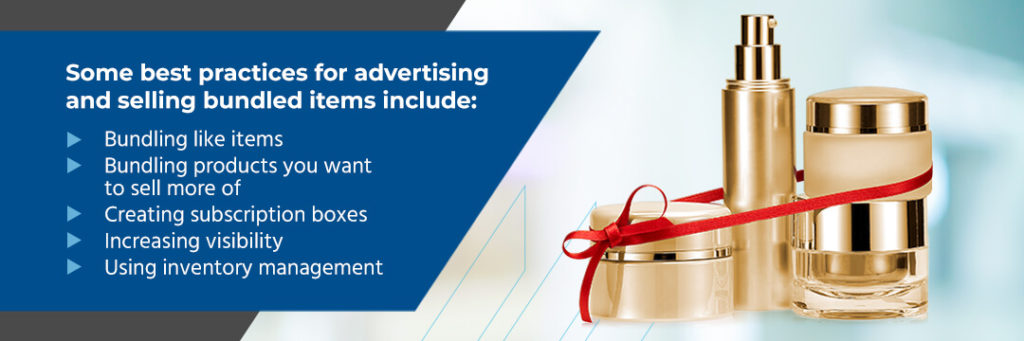
Some best practices for advertising and selling bundled items include:
Bundling like items: Take stock of all the products you sell and see which make sense to group together. Bundling products people would logically purchase or use together can entice people to buy more of those items to get a great deal. For instance, you might bundle shampoo and conditioner together or create a kit with assorted makeup products of the same brand.
Bundling products you want to sell more of: If you’re looking to sell more of a particular product, bundling it with best-sellers can be an effective way to put it on shoppers’ radars and convince them to buy it. When using this strategy, make sure you maintain a high perceived value for all products in the bundle. Customers may be more inspired to try out a low-selling product when they can get it with a product they know and love for a relatively low combined price.
Creating subscription boxes: Health and beauty subscription boxes are rising in popularity as more shoppers show an interest in curated selections of items to try. When people buy subscription boxes, they pay in advance for different product bundles to arrive at their doors each month. Subscriptions are ideal for getting shoppers excited about your brand, encouraging them to commit to receiving premium bundles regularly.
Increasing visibility: Display product sets where shoppers can see them, whether that’s front-and-center in stores or at the top of your website’s home or product pages. You can even create special sections for product bundles where shoppers can specifically browse for sets. Selling higher-priced units of multiple discounted products where shoppers are sure to see them is an effective way to drive sales and pique interest in bundles.
Using inventory management: Before packaging and shipping your business’s beauty products, organize the sales process from start to finish with an inventory management system. A flexible and secure cloud-based system will help your business save money and time, letting you control your inventory to fulfill stock and order requests. Inventory management gives you a comprehensive view of your business inventory at all times, so you’ll have all the information you need to build product sets and devise the best bundling strategies.
Benefits of Kitting and Bundling
Implementing kitting and bundling strategies can help boost your business in the following ways:
Sales increases: One of the most immediate returns your business will see from selling bundled products is an increase in sales. Many customers are willing to spend more money to get the bundled perks and may even view them as a long-term solution to their health and beauty needs. Shoppers who discover products through bundles may also purchase those items individually in the future.
Dead stock reduction: If you have items that aren’t selling well on their own, adding them to bundles can reinvigorate their appeal. Keeping your inventory moving will help you save on holding costs, create less waste and free up warehouse space for other successful items.
Lower fulfillment and material costs: Packaging several items together creates more straightforward packaging practices and lets you buy less packaging, helping you lower your costs for materials and labor.
Convenience: Bundling several products into one order consolidates the fulfillment process. Instead of packing and shipping each item separately, warehouse staff can package several items at once, which is quicker and easier.
Environmental sustainability: Using less packaging also helps reduce waste and keeps many disposable packing materials out of landfills.
Higher order values: People who buy bundles are more likely to spend more money per order than if they were purchasing each product individually. These higher order values mean your business will get more money from customers with each purchase, raising your return on investment from advertising and product design.
Lower shipping costs: Bundling personal care products lets you benefit from reduced shipping costs, as bundles often cost the same to ship as their individual items. When your company can cut back on shipping costs, your customers also pay less for shipping on their end, which increases their satisfaction and loyalty.
Learn More About Finale Inventory Today
Kitting and bundling is the perfect way for the beauty industry to drive sales increases and deliver ultimate shopper satisfaction. From cost savings to higher sales opportunities, product bundles help your business succeed while catering to the needs and interests of your dedicated customers.
Finale Inventory makes selling product bundles easier than ever. Our software tracks the inventory numbers of each item in a bundle and automatically deducts from their individual totals whenever you sell promotional product combinations. Whether you sell products individually, as bundles or both, you’ll always know exactly how much you have in stock.
Contact us today to discover everything else Finale Inventory can do for you!
“The core of maturity, that I see, is starting with a unified view of inventory. I’ve got to be able to accurately represent what do I have, make sure that I know where it’s located so I can get it to my customers quickly.”
— Troy Graham, Descartes
What is the first thing I should fix if I want to scale operations?
Start with a unified view of inventory. The core of maturity starts with being able to accurately represent what you do have and make sure that you know where it’s located to get it to customers quickly. Without a unified view across your warehouses, 3PLs, and vendors, you cannot make the best decisions because you don’t have the best information at hand.
With Inventory Visibility, Businesses Can Make Smarter Allocation Decisions
Once inventory is centralized, businesses can move from reactive updates to intentional allocation. They can decide how much inventory to expose to each channel, when to use buffers, which marketplaces need extra protection, and how seasonality or campaign performance influence availability.
Once I know what inventory I have, how should I decide where to make it available?
Inventory allocation should reflect where orders are coming from, where marketing is working, and which channels carry the most risk. Once you know what you have and where it is located, you can think more strategically using centralized inventory to make prioritization happen automatically. One fertilizer company lost a little over 5,000 orders in one weekend because someone manually uploaded the wrong available inventory to Amazon.
Better Inventory Data Improves Planning, Purchasing, and Growth Bets
Better visibility turns inventory data into a planning tool. With insight into sales velocity, inventory levels, vendors, and channel performance, businesses can make more informed replenishment decisions, avoid overbuying, and test new product lines or vendor-supplied inventory without taking on unnecessary risk.
“You have to have unified inventory to know how to price your products just at that basic level. I can’t price my products if I don’t know the true cost to get it.”
— Mike Bernico, Flxpoint
How does better inventory data help me make smarter buying decisions?
It lets you measure whether your plan is working before you commit more capital. A key question becomes: “Did my plan work? Am I overleveraged in one place or another?” Centralized systems can also help businesses test new product lines or vendor relationships by looking at sales velocity by channel, allowing them to take risks in a calculated and measured way.
Intelligent Order Routing Turns Inventory Complexity Into Automation
Once inventory and supplier data are reliable, businesses can automate fulfillment decisions. Orders can be routed based on cost, speed, margin, location, warehouse priority, vendor fallback, split-shipment rules, or customer expectations. This helps hybrid fulfillment scale because every order does not need a manual review.
How do I decide the best way to fulfill each order?
There is no single answer, which is why order routing needs to account for the context of each order. Intelligent order routing is not just sending an order to someone who has stock; it is taking each and every order and treating it like its own unique use case. Depending on the order, the business may prioritize speed, margin, an internal warehouse, vendor fallback, or preventing split shipments.
Supplier Inventory Sync Extends Inventory Beyond the Four Walls
For hybrid fulfillment to work, supplier inventory needs to become part of the operating model. Supplier sync does not always require advanced technology; it can happen through automated files, FTP, email, APIs, EDI, or ecommerce storefront integrations. The key is replacing manual updates with automated, reliable supplier data.
Can supplier inventory really be treated like part of my own inventory?
Yes, but the goal is not necessarily to force every supplier into a complex integration. Real-time supplier sync can be defined as any way to get an automated update from a supplier, such as Google Sheets, email, FTP, API, EDI, or ecommerce storefront connections. The key is that accurate supplier stock is foundational. If you don’t have an accurate view of what is in stock with your suppliers, you cannot tell your sales channel accurately what’s available.
Exception-Based Workflows Keep Humans Focused Where They Matter
Automation does not remove people from the process. Mature operations let technology handle the routine majority while humans focus on exceptions, such as high-value orders, fraud risk, compliance requirements, restricted products, export rules, or unusual fulfillment scenarios.
If my business has special cases, can automation still work?
Yes. The point is not to automate every possible decision; it is to automate the routine work and surface the exceptions. Businesses should not have to look at every single order. Instead, technology can highlight high-value orders, risky locations, or compliance requirements. The goal is to take care of the 80% of workflows that are obvious while still allowing human review when specific exceptions arise.
The Right Inventory Technology Should Fit the Business, Not Overwhelm It
Software decisions should be based on business fit, not popularity, feature volume, or broad “all-in-one” promises. Growing ecommerce businesses should identify their highest-impact bottleneck, prioritize what matters now, and choose technology that is right-sized but flexible enough to support future phases of growth.
How should I choose software without overbuying or picking the wrong system?
Start with your priorities, not the biggest feature list. Avoid an all-in-one system that claims to “do everything under the sun” and look for a “best of breed approach” with systems that can scale as you add channels or vendors. The practical advice is to stack rank what matters now, make sure the system can support future phases, and choose technology that fits your business rather than overwhelming it.
How to Scale Ecommerce Operations Beyond Spreadsheets
For many growing ecommerce businesses, Finale and Flxpoint work together as a practical answer to these challenges. Finale helps centralize and manage internal inventory, purchasing, warehouse operations, and stock visibility, while Flxpoint helps connect vendor inventory, automate supplier sync, and route orders across hybrid fulfillment networks. Together, they give businesses a best-of-breed way to improve inventory accuracy, reduce spreadsheet work, and scale fulfillment without forcing every process into a one-size-fits-all system.
Ecommerce Fulfillment Operations FAQ
What Is Ecommerce Fulfillment Operations?
Ecommerce fulfillment operations are the processes that move an online order from purchase to delivery. This includes managing inventory, syncing product availability across channels, routing orders to the right warehouse, 3PL, supplier, or vendor, and making sure the customer receives the right product on time. As discussed in the webinar, fulfillment is no longer limited to “what’s in my warehouse these days”; growing businesses may rely on internal warehouses, 3PLs, marketplace fulfillment services, and supplier inventory at the same time.
What Are Ecommerce Fulfillment Operation Examples?
Examples of ecommerce fulfillment operations include updating inventory across Shopify, Amazon, Walmart, and other sales channels; allocating inventory to specific marketplaces; sending orders to an internal warehouse, 3PL, or vendor; syncing supplier inventory through files, APIs, EDI, email, or FTP; replenishing warehouse stock based on sales velocity; and flagging exceptions such as high-value orders, compliance requirements, or restricted products. In the webinar, the speakers also discussed hybrid fulfillment examples where a business may fulfill some products from its own warehouse and use vendors as a fallback or extension of available inventory.
How Can I Track My Inventory at an Ecommerce Fulfillment Center?
The best way to track inventory at an ecommerce fulfillment center is to create a unified inventory view that shows what is available, where it is located, and how that inventory connects to each sales channel. That means tracking inventory across internal warehouses, fulfillment centers, 3PLs, marketplace fulfillment programs, and supplier locations instead of relying on disconnected spreadsheets. The webinar emphasized that businesses need to “accurately represent” what they have and know where it is located so they can get products to customers quickly.
How Can I Connect My Inventory to My Supplier?
You can connect supplier inventory through several methods, depending on what the supplier supports. The webinar discussed low-tech and advanced options, including automated Excel or CSV files, Google Sheets, email updates, FTP servers, APIs, EDI, and direct connections to ecommerce storefronts such as Shopify, BigCommerce, or Magento. The key is to ask suppliers how they share inventory today, then use a system that can automate that data flow instead of manually copying supplier inventory into spreadsheets.
What Is Ecommerce Order Routing?
Ecommerce order routing is the process of deciding where an order is fulfilled from after a customer buys. In a simple operation, every order may go to one warehouse. In a more complex or hybrid fulfillment model, the best fulfillment source may depend on inventory availability, shipping speed, cost, margin, customer location, warehouse priority, vendor fallback rules, or whether the order should be split. The webinar described intelligent order routing as treating each order like its own use case, so businesses can automate the best fulfillment decision without manually reviewing every order.